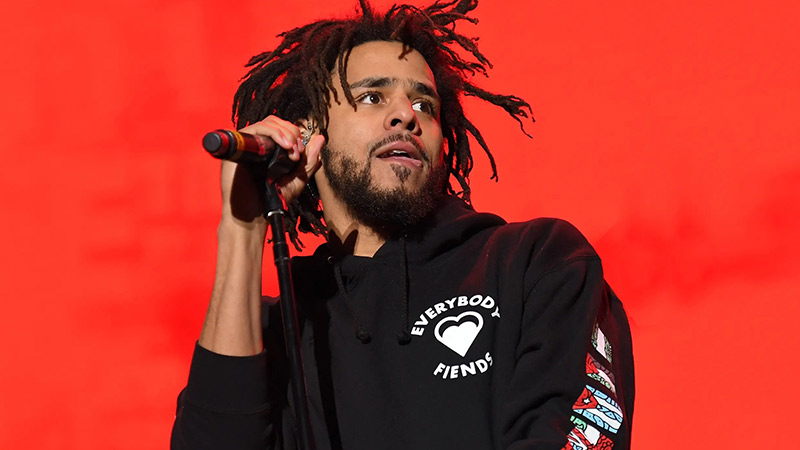
In the middle of the most sprawling media run of his career, J. Cole said something that’s been bouncing around the heads of every serious hip-hop thinker for years — he just said it out loud. The universal classic in hip-hop is dead. The era when one rap album could stop the world, collapse generational divides, and be simultaneously embraced from the corner store to the boardroom? Gone. Finished. Streamed into oblivion, fragmented by algorithm, and scattered across a thousand personalized playlists that never talk to each other.
This is the Fayetteville MC at his most clear-eyed — and his timing is not accidental.
Cole officially released The Fall-Off on February 6, 2026, his seventh and reportedly final studio album, structured as a 24-track double album split between “Disc 29” and “Disc 39.” Since then, he has been on a media tour unlike anything he’s done before — Apple Music sit-downs, campus visits, a cross-country CD-selling run in his old Honda Civic, and a face-to-face sit-down with Cam’ron on Talk With Flee to hash out a pending lawsuit. In those conversations, Cole has been pulling the curtain back on how he actually sees the business and culture of hip-hop right now. What he sees is fragmentation so severe that the very concept of a shared musical reference point no longer functions the way it used to.
He’s right. And this isn’t just a philosophical observation — it’s a crisis with real commercial and cultural implications for everyone in the industry.
Think about what a universal classic actually meant. Illmatic. The Blueprint. good kid, m.A.A.d city. Those records didn’t just sell — they became common ground. Your barber knew them. Your professor knew them. The kid in the back of the school bus and the exec in the corner office referenced the same verse. They were conversation starters, cultural benchmarks, shared vocabulary. That kind of reach required a monoculture — a world with limited channels, shared radio playlists, TRL countdowns, and word-of-mouth operating at the speed of a neighborhood. That world is gone.
This is a man who built his entire artistic identity around the idea of speaking to everyone simultaneously — conscious enough for the backpackers, melodic enough for the mainstream, real enough for the streets. And even he is admitting that the infrastructure required to do that simply doesn’t exist anymore.
The streaming era didn’t just change how we consume music. It destroyed the mechanisms by which a record becomes a moment. Spotify’s algorithm doesn’t want you to experience an album — it wants to atomize it into individual tracks and insert the best-performing one into a playlist alongside seventeen other artists you’ve never heard. Apple Music seems to not care about The Fall-Off as a cohesive artistic statement; it cares about “Disc 2 Track 2” as a stream. Radio — the original universal delivery mechanism — has been reduced to an afterthought in hip-hop, a channel that chases trends rather than creating them.
The result is that even the biggest records today exist in silos. Kendrick Lamar and SZA’s “Luther” just won Hip-Hop Song of the Year at the 2026 iHeartRadio Music Awards and swept multiple Grammys earlier this year — and yet the cultural penetration of that record barely approaches what DAMN. achieved in 2017. The numbers are there. The awards are there. The universal resonance is not. Because there is no single channel that delivers music to everyone anymore. The audience has been algorithmically sorted into tribes, and those tribes don’t interact.
For label executives, A&Rs, and brand partners building long-term artist development strategies around the pursuit of the “classic album,” Cole’s diagnosis is a critical recalibration. Even The Fall-Off itself — arguably the most carefully constructed and intentional album of Cole’s career — was described by critics as “a snapshot of craftsmanship at a high point” rather than the genre-defining statement that his earlier work seemed to promise. This isn’t a failure of artistry. It’s a failure of infrastructure.
So what do you do with that? The industry’s response so far has been to double down on the streaming metrics that replaced album culture — first-day plays, playlist placement, viral moments, pre-save counts. Kanye West’s Bully is tracking 250K–275K first-week units according to early projections, which would be a commercial success — but Ye’s Donda pulled close to 100 million streams on its first day in 2021, and nobody’s calling Bully a cultural event of that magnitude. The math is getting better. The meaning is getting thinner.
Cole’s point isn’t that great rap albums can’t be made. The Fall-Off is proof they still can. His point is that even a great album can no longer function as a universal reference — that the connective tissue of shared musical experience has been permanently severed by the streaming model. And that’s not just a problem for artists trying to build legacies. It’s a problem for a culture that uses music as its primary language.
The universal classic isn’t coming back. The industry needs to decide what fills the void — and who benefits when the answer is nobody but the platform.
The post J. Cole Says the “Universal Classic” in Hip-Hop Is Dead. He’s Not Wrong. first appeared on Rap Industry: New Hip Hop, Rap Videos, Music, News, & more..